

Agencies and mid-market marketing teams often get AI drafts that still need senior rewrites: generic, off-brand, or inaccurate. The Pragmatic Content Engine is how we build a repeatable, brand-safe content workflow when content, voice, or a knowledge base is the named problem. It is a module inside project work. Not the front door. Not a kit. Not a sprint you buy before anyone has named the stuck workflow. Most teams still start with a paid diagnosis (AI Operations Review, $997, not a retainer) or the free AI Content Review Checklist if they’re earlier.
Book the AI Operations Review ($997, not a retainer)Most agencies and fractional CMOs we work with are still losing 8–15 senior hours every week rewriting AI drafts — time that could otherwise be spent on client strategy or billable work. That cost compounds every month you wait.
“We have plenty of drafts. We just don’t have drafts we can publish without rewriting them.”
AI makes it easy to create more drafts. It does not automatically make those drafts easier to approve or publish. When you’re managing multiple clients or brands, each with their own voice, requirements, and review processes, this problem gets worse. Different writers (or even clients) using AI creates inconsistency, and senior reviewers end up redoing work that was supposed to save time.
Notes, transcripts, customer language, internal expertise, and past examples live in different places. Every prompt starts with a different version of the truth.
The team knows what sounds right, but the standards are not documented in a form AI or new team members can apply consistently.
People improvise instructions, examples, and context each time. Results vary depending on who opens the chat and what they remember to include.
Editors, approvers, and AI tools all make different changes because the team has no shared standard for what a usable draft must accomplish.
Real feedback from agencies, fractional CMOs, and marketing leaders who were dealing with the same rewrite cycle.
“Before we installed the Content Engine, our senior writers were still spending 12+ hours a week rewriting AI drafts for different clients. Now the first drafts land much closer to usable, and review time has dropped noticeably.”
— Agency Partner, multi-client content agency
“I was burning billable hours fixing AI output that still sounded generic. After putting the system in place, I finally have a repeatable workflow I can hand to freelancers without losing brand control.”
— Fractional CMO, working across 4 brands
“We were generating plenty of AI content, but almost none of it was usable without heavy rewriting by our team. Once we put the Content Engine in place, the drafts came back cleaner and on-brand, and our senior reviewers finally had time to focus on strategy instead of cleanup.”
— Marketing Director, mid-tier bank
It has two parts: a one-time setup, then a repeatable process you run every time you create content.

This is usually done once per workflow. You will:

This is the repeatable process you use every time content is created. You will:
Over time, you’ll improve the workflow by refining the prompts, examples, source material, and review standards.
If you manage content for multiple clients or brands, you know how hard it is to keep voice, quality, and process consistent when different people (or clients) are using AI.
The Content Engine helps agencies:
Many agencies start internally to improve delivery, then explore offering it to clients.
One system, many clients
Install the workflow once, then adapt brand voice and source material per client instead of rebuilding process every time.
Less senior cleanup
Shared review standards catch generic, off-brand, or weak drafts before they hit the people who bill the highest rates.
Faster onboarding
New writers, freelancers, or client stakeholders get clear inputs, prompts, and review criteria instead of tribal knowledge.
Optional client offer
Use it internally first. Later, package the same system as a managed or white-labeled service for clients who want it themselves.
The outputs change. The operating structure stays consistent.
Everything required to set up one repeatable, brand-safe AI content workflow in the tools you already use (Claude, ChatGPT, Gemini, or Copilot) so your team produces stronger first drafts, reduces senior rewrites, and maintains consistency across multiple clients.
Full Content Engine System (included)

Plus Guided Implementation
Four live 60-minute working sessions with our team
Content Engine shows up only when you name content, brand voice, or a knowledge base as the work. Usually after an AI Operations Review memo, inside Project work. We don’t sell a Content Engine Kit or Sprint as live offers anymore. Those shapes trained the wrong door. If content/KB is already on your list: (1) Start with the free AI Content Review Checklist (if you haven’t). (2) Or book the AI Operations Review ($997) so we name the stuck workflow before any build. (3) Then we scope Content Engine as a project module (comparison-first; Eng separate if needed). Not an unpaid estimate loop. What you keep when we build this module: Brand voice standards · source material map · workflow prompt path · AI content review criteria · ownership so the team can run it without us. What this is not: A prompt pack. An open-ended retainer. A cold Stripe kit. A free “we’ll send a scoped recommendation” before paid diagnosis. Prefer to wait until content/KB is explicitly on your list. That’s correct. We won’t invent a free custom proposal to keep the conversation warm.
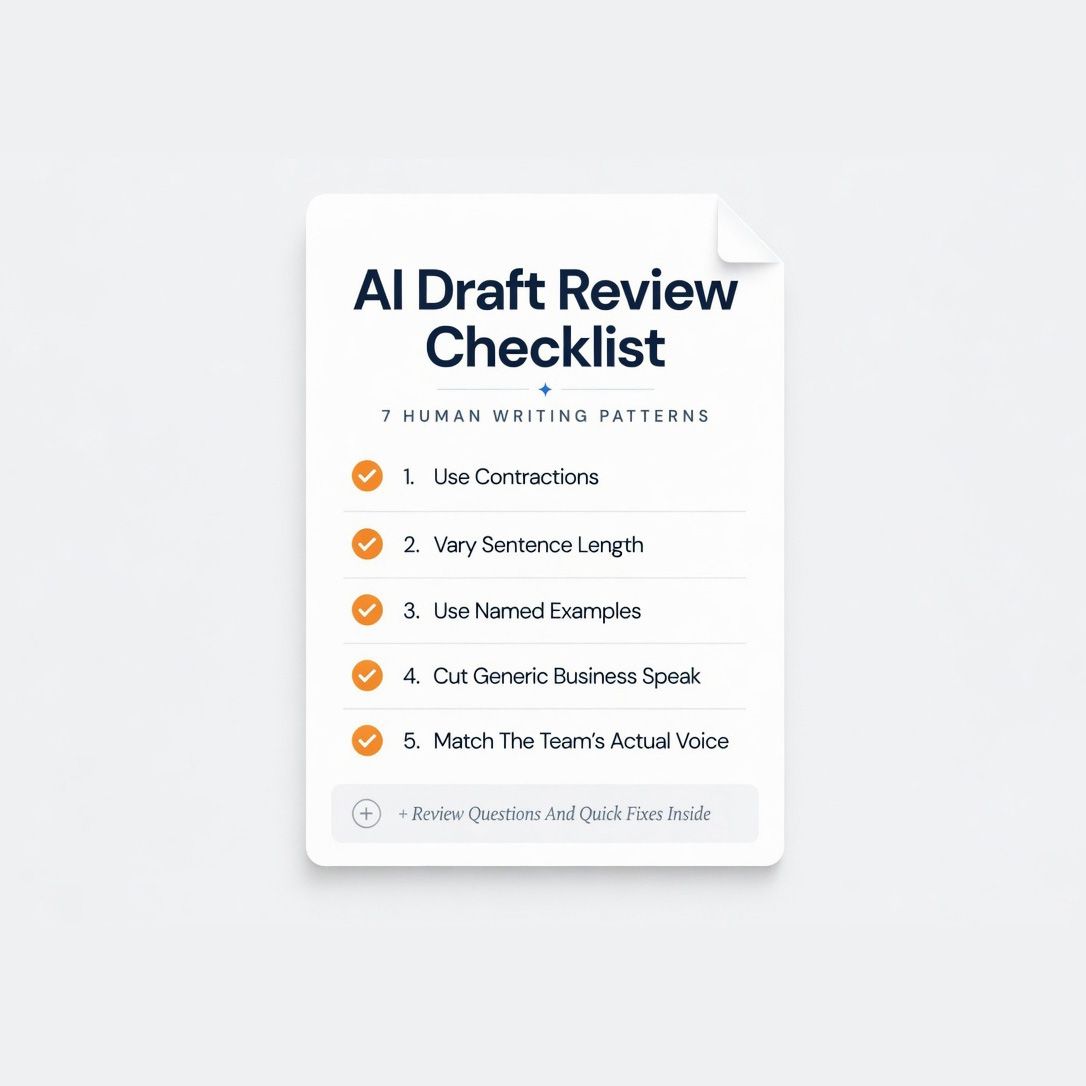
That’s Project work, scoped after we’ve named the content/KB problem (usually via the AI Operations Review). Comparison-first scope. Not a free multi-round estimate. Not a kit.
Start with the AI Operations Review ($997, not a retainer)The activation plan moves your team from scattered AI usage to one documented source-to-output workflow over four structured weeks.
Use it internally with the Content Engine Kit or work through it with Pragmatic during the Sprint.

Select one content workflow, assign ownership, organize the initial source material, and define what “on brand” and “usable” mean before prompting begins.
Outcome: One bounded workflow, a clear owner, approved source material, and an initial brand voice standard.

Create the first reusable prompt sequence using real transcripts, notes, briefs, examples, customer language, and internal expertise.
Outcome: A repeatable prompt path tied to a real workflow rather than a one-off chat.

Apply the AI Content Review System to identify weak claims, missing context, generic phrasing, robotic patterns, and brand drift.
Outcome: Shared review criteria the team can apply before a draft reaches senior approvers.

Execute the workflow, document the process, define review and approval responsibilities, and identify what should improve in the next cycle.
Outcome: One working AI-assisted content workflow with clear inputs, prompt logic, review criteria, and ownership.
The activation plan moves your team from scattered AI usage to one documented source-to-output workflow over four structured weeks.
Use it on your own with the Kit, or work through it with us during the Sprint.
When the system is in place, senior people stop rebuilding drafts and start refining them. Review becomes a decision instead of a guess. Onboarding new writers or freelancers stops relying on tribal knowledge. And the process itself gets better over time instead of resetting with every new piece of content.
The Content Engine gives human reviewers clear criteria that exist before the draft is generated. The standard does not change depending on who opens the chat or how the question is phrased.
A review system should not only catch weak work. It should also protect the work that was already right.
Stronger first drafts
Drafts arrive closer to usable. Senior people spend time refining, not rebuilding from scratch.
Less senior review time
Shared review criteria catch generic phrasing, weak claims, and brand drift before the highest-cost reviewers get involved.
Consistency across writers and clients
Different people (and different client accounts) produce work that still feels on-brand because the inputs and standards are shared.
Faster onboarding
New writers, freelancers, or client stakeholders get clear source material rules, voice guidance, and review criteria instead of tribal knowledge.
Fewer last-minute brand/accuracy issues
Problems that used to surface at approval or client review get caught earlier in a structured pass.
A process that improves over time
Each cycle can refine prompts, examples, and review standards so the workflow gets better instead of resetting every time.
Questions teams usually ask us before starting.
Content Engine is a module inside Project work when you name content, voice, or a knowledge base. Start with the AI Operations Review ($997, not a retainer) or the free AI Content Review Checklist.
Book the AI Operations Review ($997, not a retainer)
Weekly insights on AI adoption, workflow, and what's actually working in mid-market organizations.